
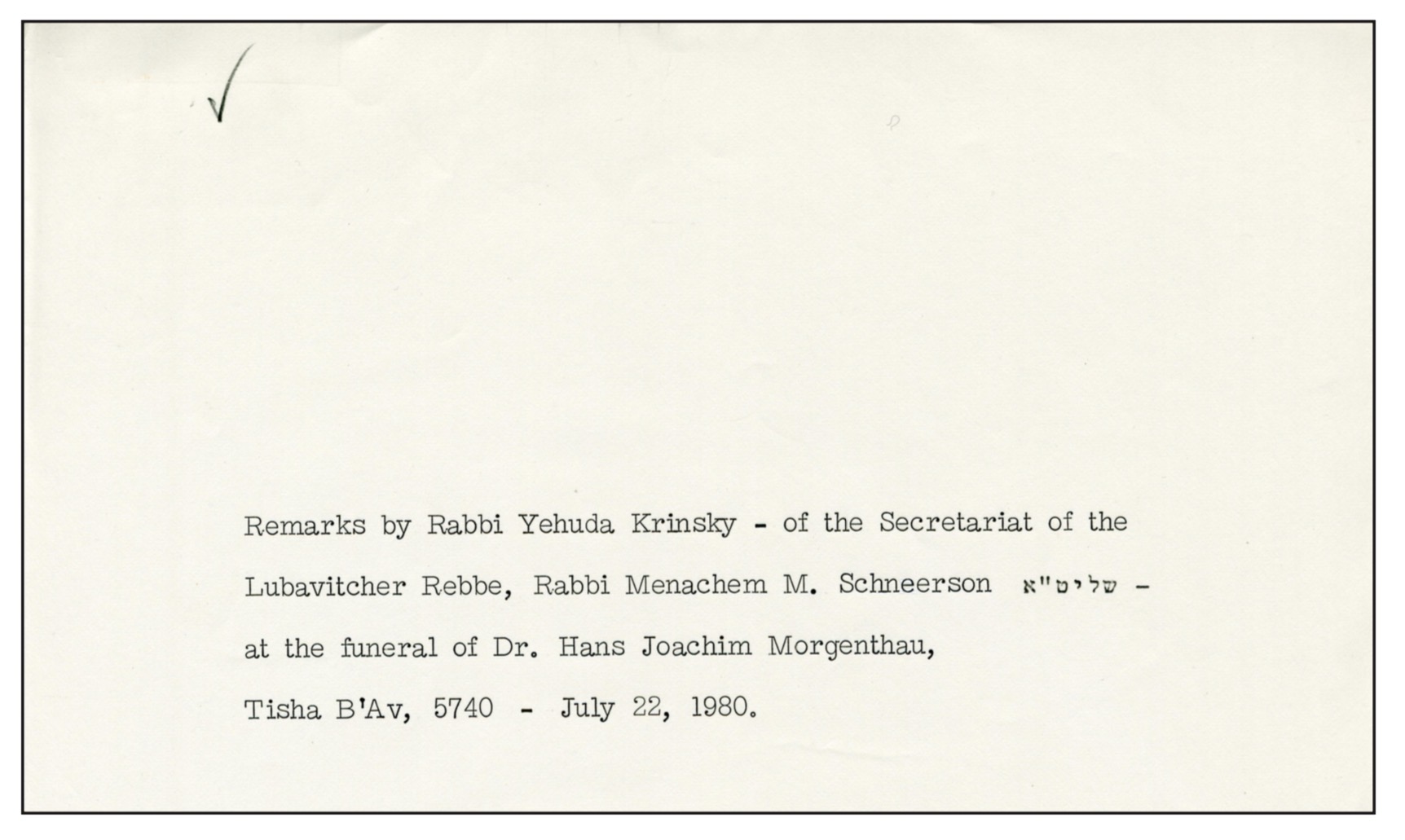
Remarks by Rabbi Yehuda Krinsky — of the Secretariat of the Lubavitcher Rebbe, Rabbi Menachem M. Schneerson שליט״א — at the *funeral of Dr. Hans Joachim Morgenthau, Tisha B’Av 5740 - July 22, 1980.
[*) In keeping with his wishes, Dr. Morgenthau was buried in full accord with traditional Jewish law and custom. The Lubavitch Burial Society was in charge of all preparations and burial. Interment was at Lubavitch grounds, at the Old Montefiore Cemetery, in the Springfield Gardens section of Queens, New York].
Today—the ninth day of the Hebrew month of Av—is by far the saddest day of the year on the Jewish calendar. The Ninth of Av marks the destruction of our Holy Temples and the City of Jerusalem. It is a day of fasting—of total abstinence from any food and drink—from before sundown last night until after sundown this evening. It is a day of mourning, a time for reflection and reciting lamentations.
But our Torah teaches us that sorrow should not be confused with despair—neither should mourning be mistaken for gloom. Our history has amply demonstrated that we can arise from the ashes and endure, and, with the observance of our Torah, endure longer than any other people—in happiness and security, with abundance and contentment, and serve as a beacon of light to the entire world.
Our sages tell us in the Midrash (Lamentations 1:51) that at the very time the flames in all their fury consumed the Holy Temple, and the treasures of our people were plundered, the Redemption of the Jewish people began—nolad Moshion VeGoalon shel Yisroel—the Liberator and Redeemer of Israel was then born.
My dear friends—this historic message of our people is applicable to us here today.
We have gathered here today to bid farewell to a beloved man.
A man who was a giant in his field of endeavor, a human being of towering character and genius, who walked with Chiefs of State and who left his imprint on history, yet remained humble and compassionate. Whose quest for learning never ceased as he imparted of his knowledge to others.
I was privileged to be privy to a side of his life perhaps unknown to most.
Dr. Hans J. Morgenthau was a very sensitive and deeply religious man—a faithful son of his people. We had many memorable conversations at various occasions, recorded indelibly in my memory. Others here today will surely address themselves to his important role in world affairs. But I must tell you that he had a special place in his heart for the Rebbe—the Lubavitcher Rebbe—after having met the Rebbe many years ago.
Visiting him not too long ago in the hospital, I conveyed to Dr. Morgenthau the Rebbe’s regards and good-wishes. And I think I detected a sentimental tear in his eyes as he said “What a great man the Rebbe. A leader—a brilliant thinker—a mover of people —a pragmatic man who has accomplished so much throughout the world for our people. And I can tell you most assuredly that he has a keen insight into world affairs.”
I am a great believer in Divine Providence. And as today’s mourning of the loss of our Holy of Holies, the Temple and our land, coincides with our farewell to Dr. Morgenthau, I wish to convey to you that which he told me with regard to the current situation in Israel; that the Camp David accord spells danger for Israel, and that any return of the West Bank territory would be a disaster for Israel and the Jewish people. This coincides with the Rebbe’s view.
Belief in life after life is a cardinal principle of Jewish faith. Belief in the future resurrection of the deceased is also a cardinal principle of Jewish faith.
The Talmud (Taanit, 5b) relates that—Yaacov Ovinu lo meis—Jacob, our forefather, never died. And the Talmud typically queries—but wasn’t he eulogized? wasn’t he buried? to which the Talmud responds—just as his children live—so does he live on!
So though we will sorely miss Yoachim ben Ludvig HaCohen Morgenthau, we take some solace in knowing that his soul will live on in its new, higher realm of life. He will live on in this world in his deeds and writings. He will live on in the hearts and minds of his students and all who knew him—and—above all—he will live in the hearts and minds of his dear children, Matthew and Shoshana.
Tehi Nafsho Tzroroh BeTzror HaChayim—may his soul be bound in the bond of eternal life.